In gold trading, strategy alone rarely determines long-term outcomes. The conditions under which trades occur — including how quickly prices can move, how much leverage amplifies exposure, and how external events shift market sentiment — play a defining role in shaping results. Risk management in gold trading is commonly described as the framework that helps market participants navigate these forces without exposing their capital to uncontrolled losses. For beginner traders, understanding why these principles exist is often more valuable than any individual trading strategy.
According to the European Securities and Markets Authority (ESMA), approximately 70–89% of retail investor accounts lose money when trading CFDs with leverage. This figure underscores how critical risk awareness is before any market participation begins.
Key Takeaways
Risk management in gold trading covers multiple dimensions of exposure, leverage, and market uncertainty.
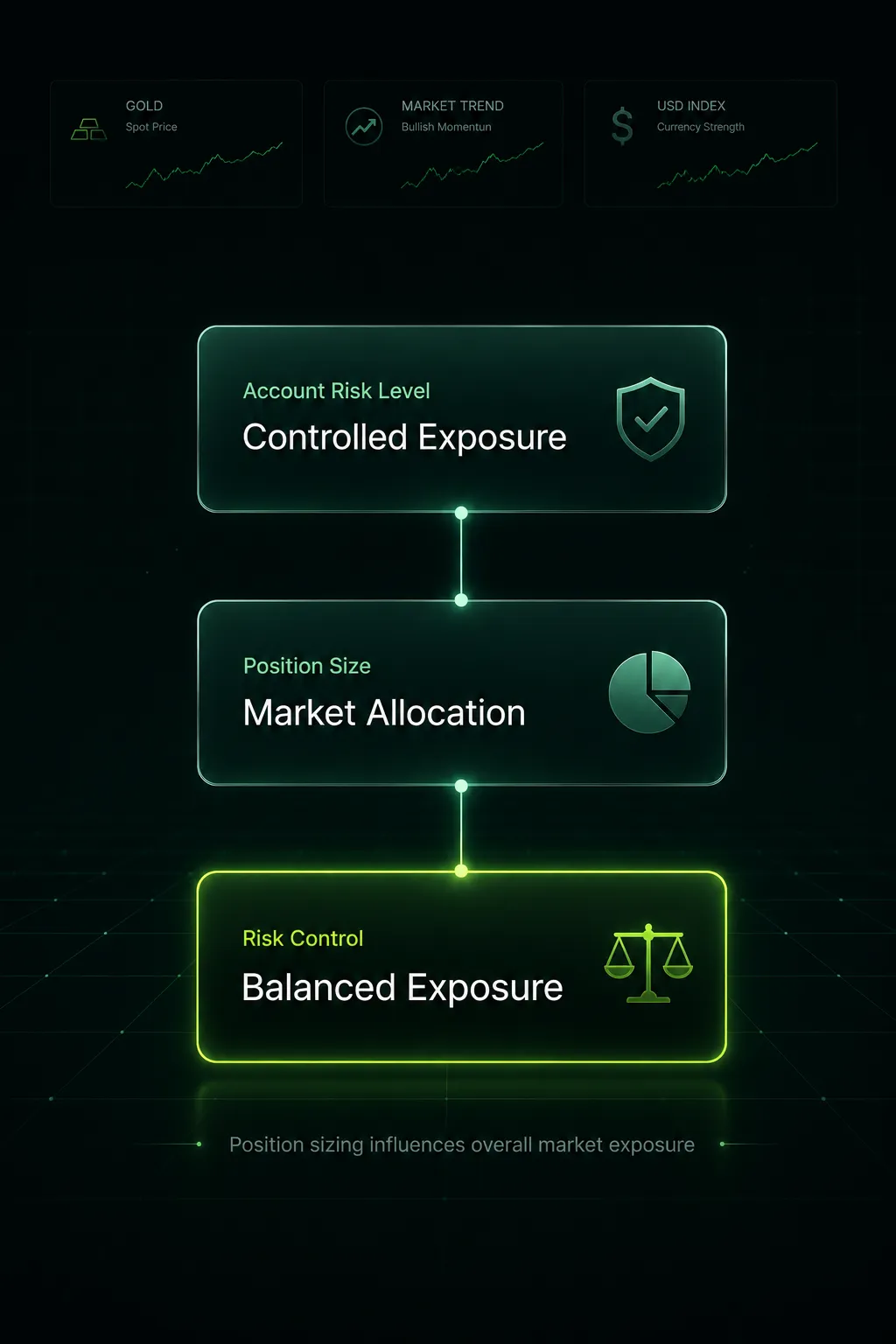
Position sizing is often considered the core element of risk control, defining capital allocation per trade.
Stop-loss orders are widely used but may be affected by slippage and price gaps in fast-moving markets.
Gold volatility can increase sharply during economic data releases, central bank announcements, and geopolitical events.
Leverage amplifies both potential gains and losses and is frequently linked to higher retail trading risk.
Diversification can reduce concentration risk but may offer limited protection during systemic market stress.
Liquidity conditions vary across sessions and can influence execution quality and trading costs.
Emotional discipline helps prevent behaviors such as revenge trading and overconfidence.
Trading technology supports analysis and monitoring but does not replace a structured risk framework.
Event-driven risk from macroeconomic and geopolitical developments can be unpredictable.
Effective risk management is associated with more controlled trading outcomes but does not guarantee profitability.
Importance of Risk Management in Gold Trading
Risk management is often considered a foundational element of sustainable trading activity, particularly in markets as dynamic as gold. Gold prices can respond rapidly to a wide range of macroeconomic and geopolitical inputs, which means that participants who do not account for this sensitivity may face outcomes that are difficult to anticipate or absorb.
The gold market is influenced by a broad combination of factors including central bank interest rate decisions, inflation data, currency strength — particularly the U.S. dollar — and geopolitical tension. These inputs can produce sharp, sudden price movements that affect open positions across all time frames.
Risk management is the foundation upon which traders minimize losses and protect their capital. Without a clear understanding of potential downside scenarios, even technically sound trade ideas may produce unfavorable outcomes due to unexpected market behavior.
Characteristics of Gold Market Volatility
Gold market volatility is shaped by a diverse set of inputs that can vary significantly across different economic environments. Safe-haven demand, driven by uncertainty in equity markets or geopolitical events, has historically caused gold prices to rise sharply within short periods.
Common sources of price fluctuation in gold include:
Central bank policy announcements and forward guidance
Inflation data releases, particularly CPI and PCE figures
Employment reports such as the U.S. Non-Farm Payrolls
Geopolitical conflicts or sudden diplomatic tensions
Shifts in the U.S. dollar index
Changes in real interest rate expectations
Global equity market stress or systemic risk events
Volatility in gold markets may differ significantly between periods of calm and periods of macroeconomic stress. During quiet market conditions, price movements may be contained and predictable. During high-uncertainty periods, gold moves can be both larger and more erratic.
Impact of Leverage on Gold Trading Exposure
Leverage allows traders to control a larger position in gold than their deposited capital would otherwise permit. A leverage ratio of 1:20, for example, means that a $1,000 deposit can control a $20,000 position. This structure increases exposure to both favorable and adverse price movements in equal proportion.
For beginner traders, leverage is among the most commonly misunderstood concepts in CFD and futures trading. Leverage does not change the probability of a trade being correct. It changes the magnitude of financial consequences when price moves against an open position. Because it carries significant risk, leverage can result in losses that exceed the original deposit in certain account types.
Relationship Between Market Risk and Capital Preservation
Capital preservation is one of the most frequently discussed goals within risk management frameworks. The concept refers to protecting the overall trading account from drawdowns severe enough to limit future participation in the market.
Market risk — defined as the possibility that an asset's price moves unfavorably — is present in all gold trading activity. Risk management helps traders to make informed decisions about how much of their capital they expose to this risk at any given time. Limiting risk per trade is often described as one of the core principles associated with long-term account sustainability.
Position Sizing as Foundation of Risk Control
Position sizing refers to the process of determining how large a gold trade should be relative to the total available capital. It is one of the most discussed concepts in risk management literature and is often described as a primary mechanism for controlling how much a single trade can affect overall portfolio performance.
The size of a gold position directly determines how much monetary gain or loss is produced per unit of price movement. Larger positions amplify both favorable outcomes and adverse ones, meaning that rules for position sizing are often tied directly to the trader's overall risk tolerance and account size.
Connection Between Position Size and Market Volatility
In higher-volatility environments, a given position size may produce larger swings in account value than the same position would during quieter market conditions. This relationship means that market participants sometimes adjust their position size in response to current volatility levels.
One tool commonly associated with volatility-based position sizing is the Average True Range (ATR) indicator, which measures the average price range of an asset over a defined lookback period. A volatility-based stop or sizing approach using ATR attempts to account for how much gold typically moves within a given session, helping market participants avoid placing stops so tight that normal market fluctuation triggers them.
Effects of Oversized Positions on Trading Performance
Oversized positions in gold trading are frequently cited as a contributor to avoidable losses. When a position size is disproportionate to available capital, even moderate price fluctuations may generate significant account drawdowns.
Market participants with large exposures relative to their account size may also face emotional pressure to close positions prematurely or hold them longer than originally intended, both of which can conflict with their original trading framework.
Effects commonly associated with oversized positions include:
Elevated sensitivity to short-term price noise
Greater psychological pressure during drawdown periods
Increased likelihood of margin calls or forced liquidation
Reduced flexibility to manage multiple positions simultaneously
Higher transaction costs relative to total capital
Capital Allocation Across Multiple Gold Positions
Distributing exposure across more than one position is sometimes discussed as a method for managing risk concentration. When capital is committed to several smaller positions rather than a single large one, the impact of an adverse move in one position may be partially offset by other outcomes.
However, multiple positions in correlated instruments — such as gold and silver, or gold and mining equities — may not provide meaningful diversification if those assets tend to move in the same direction under stress conditions.
Stop-Loss Concepts in Gold Markets
Stop-loss orders represent one of the most commonly referenced risk-control mechanisms in retail and institutional trading. In conceptual terms, a stop-loss is an instruction to close a position if the price moves to a specified level, with the general intent of limiting the amount of capital lost on that trade.
For gold traders, understanding how stop-loss orders function — and under what conditions they may not perform as expected — is a frequently discussed aspect of proper risk management education.
Purpose of Stop-Loss Orders
Stop-loss orders are generally intended to define a maximum acceptable loss on a given trade before the position is closed. This concept allows a trader to determine, prior to entering a position, how much capital is at risk if the trade moves unfavorably.
Using stop-loss orders is often described as a discipline-based practice that removes the need for real-time decisions during adverse price movement. The key function of a stop-loss level is to limit downside exposure in an environment where price can move rapidly and unpredictably.
Volatility Challenges During Fast Gold Price Movements
During high-volatility periods, stop-loss and take-profit orders may not execute at the exact price specified. This is known as slippage — a condition where the actual fill price differs from the requested price due to rapid market movement or gaps in available liquidity.
Gold markets are particularly susceptible to slippage around major news releases, central bank statements, and geopolitical announcements. In these environments, price can gap through multiple levels in milliseconds, meaning that placing stops at a given level does not guarantee execution at that exact price.
Advantages and Limitations of Automated Risk Controls
Automated protective orders, including stop-loss and take-profit levels, provide a degree of hands-off risk management that can help remove emotion from the process of closing a trade. This is often cited as a meaningful advantage for beginner traders who may struggle with discipline during periods of market stress.
Feature
Advantage
Limitation
Stop-loss order
Caps maximum loss on a trade
May be triggered by short-term volatility
Take-profit order
Locks in gain at defined level
May close trade before full trend develops
Trailing stop
Adjusts automatically with price
May react to noise in fast-moving markets
Guaranteed stop
Fills exactly at stated price
Often requires a premium fee to broker
Risk-Reward Relationships in Gold Trading
The concept of risk-reward relationships describes the theoretical comparison between the potential profit a trade offers and the potential loss it might produce. In market analysis, this framework is frequently discussed as a way of evaluating whether the perceived upside of a trade is proportionate to the risk being taken.
Risk-reward analysis is descriptive rather than predictive. It does not indicate the likelihood that a particular outcome will occur — it only expresses the relative magnitudes involved if the anticipated and the adverse scenarios each materialize.
Historical Use of Risk-Reward Analysis
Market participants have historically used risk-reward frameworks to assess whether the structure of a potential trade justifies the capital being committed. A trade that risks a large amount to gain a small amount may be described as having an unfavorable risk-reward profile, while the reverse would be considered more efficient from a capital management perspective.
In gold trading strategies, analysts sometimes describe setups where the distance to a potential target is meaningfully larger than the distance to a defined stop level. According to some analysts, this type of structure is associated with more sustainable trading approaches over time, though past performance does not guarantee future results.
Influence of Market Conditions on Risk-Reward Profiles
Market conditions can significantly alter the practical value of a predefined risk-reward structure. During periods of heightened volatility, price movements may be faster and less predictable, which can affect both the probability of reaching a target and the likelihood that a stop level will be triggered prematurely.
Liquidity conditions also play a role. In less liquid gold market environments — such as overnight sessions or periods of thin trading — the cost of executing a trade may increase through widened spreads, effectively reducing the net reward available from any given setup.
Limitations of Risk-Reward Metrics
Risk-reward analysis, while useful as a conceptual tool, carries several limitations that are often discussed in trading literature:
It does not account for the probability of either outcome occurring
It assumes defined stop and target levels will be filled at exact prices
It does not incorporate changing conditions over the life of a trade
It may create a false sense of precision in uncertain market environments
Losses may exceed initial expectations if slippage or gaps occur
Diversification and Exposure Management
Diversification is a risk management concept that involves distributing capital across multiple assets or instruments rather than concentrating exposure in a single trade or market. In the context of gold trading, diversification may refer to spreading exposure across different instruments, time frames, or asset classes to reduce the impact of a single adverse outcome.
Concentration risk — the risk that arises from excessive exposure to one asset — is among the most frequently cited contributors to large drawdowns in undiversified trading accounts.
Concentration Risk in Gold-Focused Trading Activity
When a significant portion of available trading capital is directed toward a single asset such as gold, the performance of the overall account becomes closely tied to the behavior of that one market. A prolonged adverse move in gold prices, driven by factors such as a rising U.S. dollar or declining inflation expectations, may then produce disproportionate losses.
Risk mistakes often stem from this type of concentration, particularly among beginner traders who may focus heavily on a single instrument they feel they understand well.
Correlation Between Gold and Other Asset Classes
Gold's price behavior has historically shown relationships with other asset classes, though these relationships may change depending on the market environment:
Asset Class
Historical Relationship to Gold
Notes
U.S. Dollar (DXY)
Generally inverse
Strong dollar often pressures gold prices
U.S. Treasury Yields
Generally inverse
Rising real yields can reduce gold appeal
Equities (S&P 500)
Mixed correlation
May diverge during risk-off periods
Silver
Generally positive
Both respond to similar macro drivers
Oil
Loose positive correlation
Both influenced by inflation expectations
Portfolio-Level Risk Considerations
For individuals who hold gold alongside other financial instruments or investments, the behavior of gold as a portfolio component has historically included periods where it moved independently from equities — a characteristic sometimes described as a safe-haven quality.
However, during systemic market stress, correlations across all assets tend to increase. In these periods, the diversification benefit of including gold alongside other instruments may diminish as participants sell all available liquid assets simultaneously to raise cash.
Managing Volatility Risk in Gold Markets
Volatility risk is one of the primary risk factors associated with gold trading activity. The gold market is known for periods of sharp and rapid price changes, particularly during high-impact economic announcements or geopolitical developments. Managing exposure during these periods is often discussed as an essential component of any risk management plan.
Market participants sometimes reduce their position size or increase the distance of protective stops prior to major news events, in recognition of the potential for wider-than-normal price swings.
Economic Announcements and Volatility Spikes
Several categories of economic releases have historically produced significant price movement in gold markets:
U.S. Consumer Price Index (CPI) and Producer Price Index (PPI) reports
Federal Reserve interest rate decisions and meeting minutes
Non-Farm Payroll employment reports
Gross Domestic Product (GDP) releases
Personal Consumption Expenditures (PCE) inflation data
Unemployment rate figures and jobless claims data
Each of these releases can shift expectations for interest rates or inflation — two of the primary drivers of gold prices — within seconds of publication.
Geopolitical Events and Safe-Haven Demand
Gold has long been associated with safe-haven demand during periods of geopolitical tension or global uncertainty. Historical examples include periods of military conflict, trade disputes, energy crises, and financial system instability, all of which have at times been associated with increased interest in gold as a store of value.
Geopolitical events can develop suddenly and without predictable timing, which means that gold market exposure during periods of global tension may carry elevated uncertainty even when technical or fundamental conditions appear stable.
Volatility Indicators Used in Market Analysis
Several analytical tools are commonly associated with volatility assessment in gold markets. Analytical software platforms such as TradingView offer access to many of these indicators. Commonly referenced indicators include:
Average True Range (ATR): Measures average daily price range over a set period
Bollinger Bands: Expands and contracts relative to recent price volatility
VIX (CBOE Volatility Index): A proxy for broader market uncertainty that sometimes correlates with gold activity
Historical Volatility (HV): Compares current price range to past periods to assess relative calm or stress
Emotional Discipline and Behavioral Risk
Emotional trading is frequently cited in trading psychology literature as one of the most significant barriers to consistent risk management. The psychological pressures associated with watching an open position move adversely — or the overconfidence that can accompany a winning streak — may lead market participants to make decisions that deviate from their stated risk management plan.
For beginner traders, developing awareness of emotional responses to market conditions is often described as equally important as learning technical or fundamental analysis.
Impact of Fear During Market Declines
When gold prices move sharply against an open position, fear-driven responses may lead to premature exits at unfavorable levels, or alternatively, to paralysis where a losing position is held far beyond the intended stop level in hope of recovery.
Both outcomes are associated with the absence of a clear, pre-defined risk management approach. Emotional decisions made under pressure are often cited as a leading driver of significant losses in retail trading accounts.
Influence of Greed During Strong Price Trends
Strong upward trends in gold prices can encourage excessive optimism, sometimes leading market participants to increase their position size beyond what their risk plan would normally allow. This behavior — sometimes called "adding to winners" without adequate risk controls — can result in disproportionate exposure if the trend reverses unexpectedly.
Overtrading and revenge trading are two specific behavioral patterns frequently discussed in the context of emotional risk. Revenge trading refers to the tendency to increase trading activity and risk exposure following a loss, in an attempt to recover capital quickly. This approach often amplifies losses rather than reversing them.
Role of Consistency in Risk Management Approaches
Consistency is commonly emphasized in trading psychology discussions as a core attribute of sustainable performance. A risk management plan that is applied consistently — regardless of recent outcomes — is generally considered more effective than one that is adjusted based on short-term wins or losses.
Discipline in this context does not refer to restricting opportunity, but to maintaining predefined risk parameters even during periods when emotional responses suggest otherwise. The World Gold Council and various financial regulators have noted that emotional decision-making under pressure is among the most commonly observed factors in retail trading losses.
Liquidity Risk and Market Execution Factors
Liquidity risk in gold trading refers to the possibility that a position cannot be entered or exited at the desired price due to insufficient market participation or depth. While gold is generally considered one of the more liquid commodity markets globally, liquidity conditions can vary significantly across different trading sessions, market conditions, and instrument types.
Understanding how liquidity conditions affect execution quality is an important part of managing execution-related costs and risks.
Market Depth and Order Execution
Market depth refers to the volume of buy and sell orders available at various price levels in the order book. In a deep gold market, large orders can generally be filled close to the quoted price. In a thin market, the same order may move the price before it is fully filled — a phenomenon known as market impact.
Day trading gold during periods of low market depth — such as early Asian session hours or holiday periods — may expose participants to wider spreads and higher slippage than would typically be observed during the London or New York trading sessions.
Spread Expansion During Volatile Conditions
The bid-ask spread represents the difference between the price a market maker is willing to buy gold and the price at which they are willing to sell it. During stable, high-liquidity periods, this spread may be very narrow. During periods of heightened uncertainty or low participation, spreads can widen considerably.
Spread expansion increases the effective transaction cost of each trade. A wider spread means that a position must move further in the favorable direction before it becomes profitable. For swing trading gold — where positions may be held over multiple days — this effect may be less significant than in shorter-term day trading activity.
Differences Between Trading Sessions
Gold trading activity and liquidity tend to vary across global market hours:
Asian Session: Generally lower liquidity and wider spreads; limited participation from major institutional players
London Session: Significant gold market activity; major trading hub with deeper liquidity
New York Session: High activity, particularly when overlapping with London hours; often the most liquid period
London-New York Overlap: Historically the most active trading session for gold with the tightest spreads
Timing of trade execution relative to these sessions is a commonly discussed factor in analyses of execution cost management.
Event Risk and Macroeconomic Drivers
Macroeconomic events represent a distinct category of risk in gold markets, separate from technical price behavior or liquidity conditions. These events can produce sudden, significant price movements that affect all open positions regardless of their underlying technical or fundamental rationale.
For beginner traders, awareness of the economic calendar — the scheduled release dates of major data and announcements — is commonly described as a basic element of event risk management.
Central Bank Policy Announcements
Central bank communications, particularly from the U.S. Federal Reserve, have historically been among the most impactful events for gold prices. Changes in interest rate expectations — whether through actual rate decisions or forward guidance in meeting minutes and press conferences — can produce substantial and rapid price moves in gold.
Gold rises in environments where real interest rates are expected to decline, and may fall when rate expectations increase. This relationship exists because gold does not pay interest or dividends, making it relatively more or less attractive depending on the opportunity cost of holding it.
Inflation Data and Interest Rate Expectations
Gold has historically been associated with inflation hedging. When inflation data comes in above expectations, some market participants interpret this as increasing the probability of continued or accelerating purchasing power erosion — a condition under which gold may be viewed as a store of value.
Conversely, when inflation moderates or when central banks signal aggressive tightening, gold market sentiment may shift negatively. The relationship between gold and inflation is not mechanically consistent across all periods, making it a factor to understand conceptually rather than rely upon as a predictive rule.
Currency Movements and U.S. Dollar Influence
Gold is priced globally in U.S. dollars, meaning that changes in the value of the dollar have a direct mathematical effect on the price of gold for international buyers. When the U.S. dollar strengthens relative to other currencies, gold becomes more expensive for holders of other currencies, which can reduce global demand and exert downward price pressure.
The inverse relationship between the U.S. Dollar Index (DXY) and gold is among the most frequently observed correlations in commodity markets, though it is not absolute and may diverge during periods of broad-based risk aversion or specific dollar-related events.
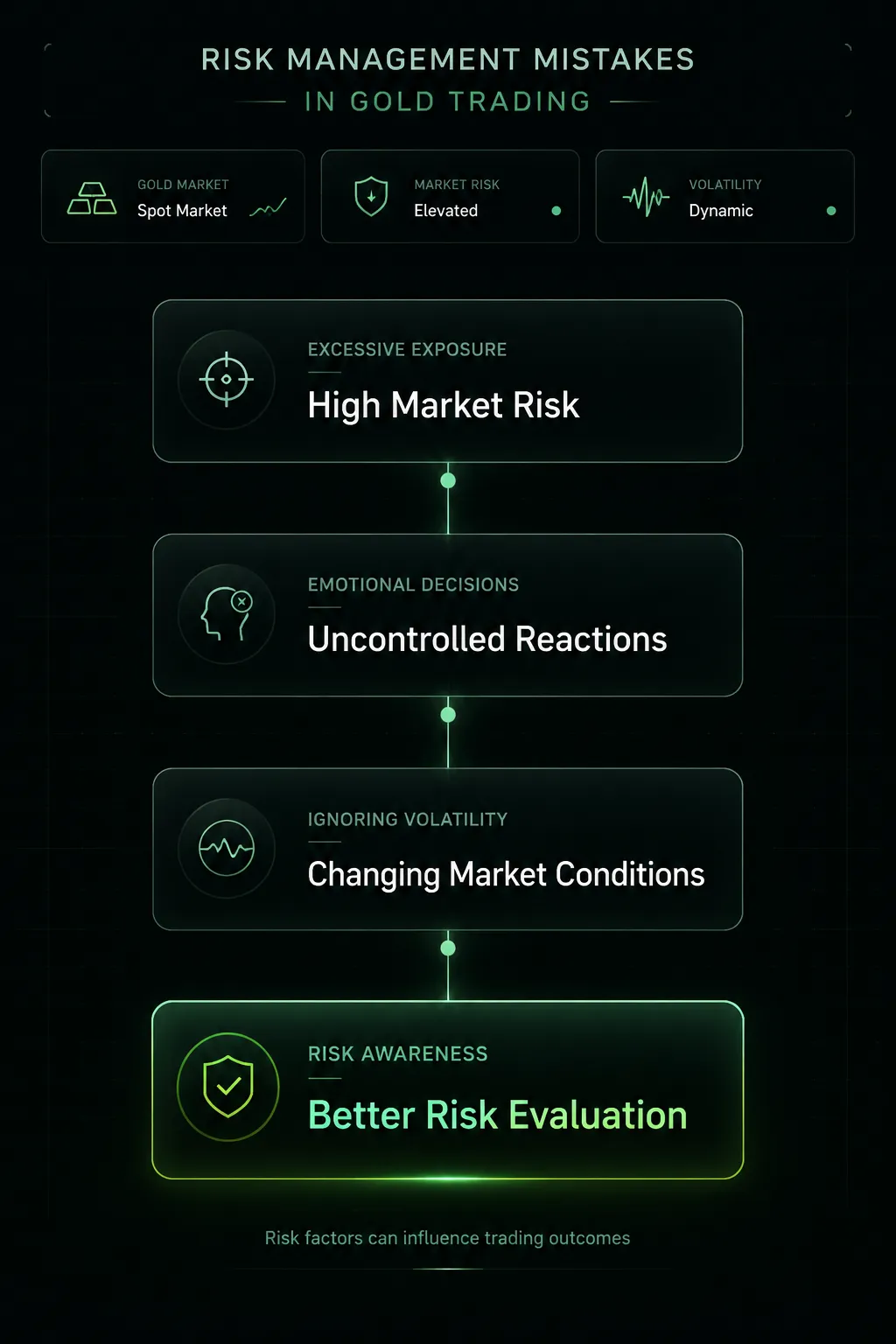
Common Risk Management Mistakes in Gold Trading
Risk management mistakes represent one of the most commonly discussed topics among gold trading analysts and educators. Understanding the types of errors that frequently occur — and the conditions under which they arise — can help beginner traders develop a more informed approach to market participation.
The majority of these mistakes stem not from a lack of strategy, but from inconsistent application of risk principles during periods of market stress or emotional pressure.
Excessive Leverage Exposure
High leverage is among the most frequently identified contributors to significant losses in retail gold trading. When leverage amplifies the size of a position beyond what the available capital can comfortably sustain, even modest adverse price movements can create margin calls or forced liquidation of positions.
Risk management strategies for addressing leverage risk often involve calculating the effective position size in monetary terms — not just in lots or contracts — before committing to a trade. "Never risk more than the account can withstand in a single trade" is a principle commonly stated in risk management educational content.
Ignoring Changing Market Conditions
Gold trading strategies that perform well in trending markets may produce unfavorable results in range-bound or highly volatile conditions. Market participants who apply static trading system rules without accounting for shifts in volatility regime, liquidity, or macroeconomic environment may find their approach becomes less effective over time.
Adapting to changing conditions does not necessarily mean changing strategy frequently. It more commonly refers to adjusting position size, stop-loss distance, or trading frequency in response to measurable changes in market behavior.
Emotional Decision-Making Under Pressure
Emotional trading under pressure — particularly during drawdown periods — is consistently cited as a risk factor that can compound initial losses. Decisions to abandon a risk management plan mid-trade, increase position size to recover losses, or exit positions without reference to predefined levels are all associated with this category of risk.
Keeping risk decisions anchored to a pre-trade plan, rather than real-time emotional responses, is commonly described as one of the most practical elements of effective gold trading risk management.
Overconfidence Following Winning Periods
A sequence of successful trades can sometimes lead to an underestimation of risk. Overconfidence following winning periods may manifest as increased position sizes, reduced attention to stop-loss levels, or a belief that recent positive outcomes reflect skill rather than a combination of skill and favorable market conditions.
Success in gold trading over a short period does not guarantee future results. Risk management practices that function well during favorable conditions must also be stress-tested conceptually against adverse scenarios to ensure they remain appropriate when market conditions change.
Technology and Modern Risk Management Tools
Modern trading platforms and analytical tools have significantly expanded the range of risk monitoring capabilities available to market participants at all experience levels. For beginner traders, these tools can provide real-time visibility into account exposure, position-level risk, and market conditions — though the tools themselves do not replace the need for an underlying risk management framework.
Technology supports risk management; it does not substitute for it. Risk management tools are only effective when used within a clearly defined approach to position sizing, exposure limits, and behavioral discipline.
Trading Platforms and Risk Monitoring Features
Trading platforms such as MetaTrader 4 and TradingView provide a range of built-in risk monitoring functionalities. These typically include:
Real-time unrealized profit and loss tracking per position
Margin level and free margin indicators
Stop-loss and take-profit order placement at the point of trade entry
Price alerts for defined levels of gold market activity
Position summary views showing aggregate exposure across instruments
A demo account is commonly recommended for beginner traders as a way to become familiar with platform risk controls before committing real capital.
Automated Alerts and Market Notifications
Many modern trading platforms and data services allow participants to set automated alerts when gold prices reach specified levels, when volatility indicators move beyond defined thresholds, or when important news events are scheduled. These tools help market participants stay informed about changing conditions without requiring continuous active monitoring.
Automated alerts do not execute trades independently — they notify the user so that an informed response can be considered. This distinction is important for understanding the role of technology in risk management versus decision-making.
Analytical Software and Data Visualization
The growing availability of data visualization tools has made it easier to assess risk characteristics such as historical volatility, correlation between instruments, drawdown history, and trade performance by market condition. These tools are used both for pre-trade analysis and for post-trade review of risk management effectiveness.
Risk management is often strengthened by reviewing historical performance data to identify patterns in when and how losses occurred. This process — sometimes called a trading account review — helps market participants understand whether their results reflect a consistent risk management approach or one that has been applied unevenly over time.
Frequently Asked Questions
Why is risk management important in gold trading?
Risk management is important in gold trading because gold prices can experience sudden and significant movements in response to economic data, central bank policy changes, geopolitical events, and shifts in investor sentiment. Without a defined framework for controlling exposure, these movements can produce losses that are disproportionate to the trader's original intent. Risk management helps traders minimize losses by establishing predefined limits on how much capital is placed at risk in any given trade or trading period. For beginner traders in particular, this structure can reduce the impact of emotional decision-making during volatile market conditions.
What factors create risk in gold markets?
Risk in gold trading originates from multiple sources. Volatility is one of the most direct factors — gold prices can move sharply within short periods in response to macroeconomic announcements. Leverage amplifies exposure to these price movements, potentially increasing losses well beyond the initial margin. Liquidity conditions affect execution quality, meaning that the actual fill price may differ from the expected price during high-volatility or low-participation periods. Geopolitical events can introduce sudden and unpredictable shifts in demand for gold as a safe-haven asset. Additionally, behavioral factors such as emotional trading and overconfidence represent internally driven risk that is not tied to external market conditions.
How does leverage affect gold trading risk?
Leverage allows a trader to control a position in gold that is larger than their deposited capital would otherwise support. A leverage ratio of 1:10, for example, means that a $500 deposit controls a $5,000 position. While this magnifies potential gains if the trade moves favorably, it equally magnifies losses if the price moves against the position. Use leverage without a corresponding adjustment in position sizing or stop placement and the risk of losing money increases substantially. Regulatory bodies such as ESMA have introduced leverage limits for retail clients in CFD markets specifically because of the outsized losses that high leverage can produce.
Can diversification reduce gold trading risk?
Diversification can reduce concentration risk — the risk that comes from having all capital exposed to a single asset or trade outcome. By distributing exposure across multiple instruments or positions, an adverse move in one does not necessarily impact the entire account equally. However, diversification has meaningful limitations. During periods of systemic market stress, gold, equities, currencies, and commodities can all move in the same direction simultaneously as participants raise cash by selling liquid assets. In these conditions, diversification may offer less protection than it does during normal market environments. "Diversify across instruments" is a commonly cited principle, but it does not eliminate the possibility of broad portfolio losses.
Which economic events often affect gold prices?
Gold prices are commonly associated with reactions to several categories of economic events. U.S. inflation data — particularly the Consumer Price Index (CPI) and the Personal Consumption Expenditures (PCE) index — often produce significant gold market movement because inflation expectations directly influence the perceived value of holding a non-yielding asset like gold. Federal Reserve interest rate decisions and accompanying communications are also among the most impactful scheduled events. Non-Farm Payroll employment reports, GDP releases, and geopolitical developments have historically been associated with volatility spikes in gold markets as well.
What role does trading psychology play in risk management?
Trading psychology addresses the influence of emotions and cognitive biases on financial decision-making. In the context of risk management, psychological factors can lead traders to deviate from predefined exposure limits, ignore stop-loss levels, or increase position size in response to recent losses — a pattern known as revenge trading. Solid risk management frameworks are partly designed to reduce dependence on real-time emotional judgment by establishing rules before trades are entered, thereby providing a structure that can be followed even under psychological pressure.
Articles by the Vida Markets editorial team cover how the forex, commodities, indices and crypto markets work, with a focus on trading costs, leverage and risk management.
Cookies
We use cookies to enhance your browsing experience and analyze site traffic. Choose "Accept" to allow analytics cookies, or "Reject" to keep only the essential ones. Cookie Policy